
1. Introduction
You’ve been asked to submit a certified translation of your birth certificate for a visa application. What exactly does “certified” mean? Who can certify a translation? Is it the same as a sworn translation? And how can you be sure your translation will be accepted?
The problem is that “certified translation” means something different in different countries and within each country there are often different requirements for different use cases. It is crucial to understand these requirements as choosing the wrong type of translation, or having it certified incorrectly, can result in rejected visa applications, delays to legal proceedings or additional expense.
In this guide I will attempt to shed some light on the matter both from the translator’s and client’s perspective and hopefully clear up some of the confusion.
2. What is a certified translation?
Although the terminology varies from country to country, the underlying purpose of a certified translation is remarkably consistent: to provide an accurate translation that can be relied upon by an official authority. According to the Chartered Institute of Linguists (CIOL), a certified translation is “one that fulfils the requirements in the country in question, enabling the certified translation to be used in formal procedures”. In practice, what this means is that the translation is accompanied by a signed certificate attesting to the accuracy of the translation. The exact wording and format of this certificate vary according to the requirements of the receiving authority but all must contain certain essential elements which I will explain in more detail below.
3. Who can certify a translation?
In the UK for example, any translator can certify their own translation provided that all the essential components of the certification are included. That being said, it is more likely to be accepted if certified by a member of a recognised professional body such as the CIOL, ITI or ATC. In jurisdictions such as Spain for example, only a sworn translator accredited with the Ministry of Foreign Affairs, European Union and Cooperation (MAEC) can certify translations into Spanish for official purposes. In Italy, the translation must be sworn (asseverata) before the court.
4. Who needs a certified translation?
You may be asked to provide a certified translation whenever an official authority needs to rely on a document that was originally issued in another language. This most commonly arises when dealing with government departments, courts, universities or other public bodies.
Typical situations include:
Immigration and residency
Whether you are applying for a visa, residence permit or citizenship, immigration authorities often require certified translations of documents such as:
- birth, marriage and death certificates;
- passports and other identity documents;
- criminal record or background checks;
- bank statements;
- tax returns;
- other supporting documents relevant to your application.
Education and professional recognition
If you are planning to study or work abroad, you may need certified translations of:
- academic certificates and transcripts;
- professional qualifications and licences;
- employment references or other supporting documentation.
Family and civil matters
Certified translations are frequently required for:
- marriages;
- divorces;
- adoptions;
- inheritance matters;
- civil registration of births and deaths.
Legal proceedings
Courts and legal practitioners may require certified translations of documents such as:
- court orders and judgments;
- pleadings;
- witness statements;
- powers of attorney;
- wills;
- property deeds.
Business and corporate matters
Companies operating internationally may also require certified translations of:
- articles of association;
- certificates of incorporation;
- shareholder agreements;
- board or shareholder meeting minutes;
- financial statements.
The exact requirements vary depending on the receiving authority. For example, the UK Home Office, Spanish public authorities and Italian government bodies each have their own rules regarding certification, sworn translations and legalisation.
In some cases, a certified translation alone is sufficient. In others, the receiving authority may also require the translation to be notarised or accompanied by an apostille.
This is where the terminology can become confusing, but don’t worry. The next section explains exactly what these different terms mean and when each one is required.
5. Certified, Sworn, Notarised or Apostilled?
As if certified translation wasn’t confusing enough, you may also come across terms such as sworn translation, notarisation and apostille. These are often used interchangeably in everyday conversation, but they are not the same thing. To make matters more confusing, their meaning and legal effect vary from one country to another.
Before you start pulling your hair out, here’s a simple guide to what each term means.
Certified translation
A certified translation is a translation accompanied by a signed statement (often called a certificate of accuracy) in which the translator certifies that the translation is a true and accurate representation of the original document.
Although the exact requirements vary depending on the authority requesting the translation, the certificate will usually include:
- the translator’s name and contact details;
- the date of certification;
- the translator’s signature;
- a statement confirming that the translation is true and accurate (sometimes qualified with the statement to the best of the translator’s knowledge and belief).
Where applicable, the translator’s professional qualifications or membership of recognised bodies such as the Chartered Institute of Linguists (CIOL) or the Institute of Translation and Interpreting (ITI) should also be included, as these provide additional assurance of the translator’s competence.
Sworn translation
A sworn translation is a legal concept recognised in some countries, but not in the United Kingdom.
In Spain, for example, only translators accredited by the Ministry of Foreign Affairs, European Union and Cooperation (MAEC) may produce sworn translations for official use. Their translations bear the translator’s official stamp and signature and are accepted by Spanish public authorities without any further certification.
Italy operates a different system. Rather than having a register of sworn translators, translations intended for official purposes are generally sworn (asseverated) before a court, following procedures that vary depending on the receiving authority.
Because there is no government-regulated system of sworn translators in the UK, the term sworn translation is sometimes incorrectly used to describe a certified or notarised translation.
Notarisation
Notarisation does not certify the translation itself.
Instead, a notary public verifies the identity of the translator (or other person signing the certificate) and witnesses their signature. The notary’s seal therefore confirms the authenticity of the signature, not the linguistic accuracy of the translation.
Some foreign authorities require certified translations to be notarised before they will be accepted.
Apostille (Legalisation)
An apostille is a certificate issued by the competent authority in the country where a public document originates. In the United Kingdom, apostilles are issued by the Foreign, Commonwealth & Development Office (FCDO).
It is important to note that, in many cases, it is the original document that must be apostilled before it is translated. Since an apostille can only be issued by the country that originally issued the document, a UK birth certificate, for example, must be legalised in the UK, while a Spanish marriage certificate must be legalised by the competent Spanish authority.
An apostille does not verify the accuracy of a translation. Rather, it confirms the authenticity of the signature, seal or official capacity of the person who issued the original public document, enabling it to be recognised in another country under the Hague Apostille Convention.
Depending on the requirements of the receiving authority, the apostille itself may also need to be translated along with the underlying document. For this reason, it is often advisable to obtain the apostille before commissioning the translation, thereby avoiding the need for the translation to be updated or repeated at a later stage.
In some circumstances, where a translated document itself also requires legalisation, the translation may first need to be certified and, in some cases, notarised before an apostille can be obtained.
In short: A certified translation confirms the accuracy of the translation; a sworn translation is a country-specific legal status; notarisation verifies a signature; and an apostille authenticates an official document or signature for international use.
6. What Makes a Good Certified Translation?
One of the most common questions clients ask is: how do I know whether a certified translation is any good?
The obvious answer is that it should be accurate and faithful to the original. But what does that actually mean?
Unlike mathematics, translation rarely produces a single “correct” answer. There are often several perfectly acceptable ways of expressing the same idea in another language. The skill lies in choosing the approach that best suits the purpose of the translation.
What does “faithful” really mean?
In many forms of translation, the priority is to communicate naturally with the target reader. Take the English expression “it’s raining cats and dogs”. A literal translation into Spanish would sound absurd. Instead, a translator would normally use the equivalent idiom llueve a cántaros (“it’s raining jugs”), allowing the Spanish reader to understand the intended meaning rather than the individual words.
Certified translation serves a different purpose.
Here, the translator’s role is not to rewrite or adapt the text for a new audience, but to produce a document that reflects the original as faithfully as possible. Legal terminology, names of institutions, document structure and even unusual wording may need to be preserved because the legal authority remains with the original document, not the translation.
Translation scholars often describe this approach as foreignization: rather than bringing the text closer to the reader, the translator brings the reader closer to the source text, preserving its linguistic and cultural characteristics wherever possible.
This does not mean translating word for word. Instead, it means making carefully considered decisions that prioritise fidelity to the original document over stylistic elegance or cultural adaptation.
Why qualifications matter
This is where a translator’s training and professional experience become invaluable.
Producing a certified translation is not simply a matter of knowing two languages. It requires an understanding of legal concepts, documentary conventions and established translation methodologies, enabling the translator to judge when to preserve the form of the original and when a more natural rendering is appropriate.
Professional qualifications and memberships of recognised bodies such as the Chartered Institute of Linguists (CIOL) or the Institute of Translation and Interpreting (ITI) demonstrate that a translator has been trained to make these judgements consistently and responsibly.
Ultimately, a good certified translation is one that faithfully represents the original document while meeting the requirements of the authority for which it is intended.
7. What does a certified translation look like?
There are two parts to a certified translation: the translation itself and the accompanying certification, each of which are explained in more detail below.
The Translation
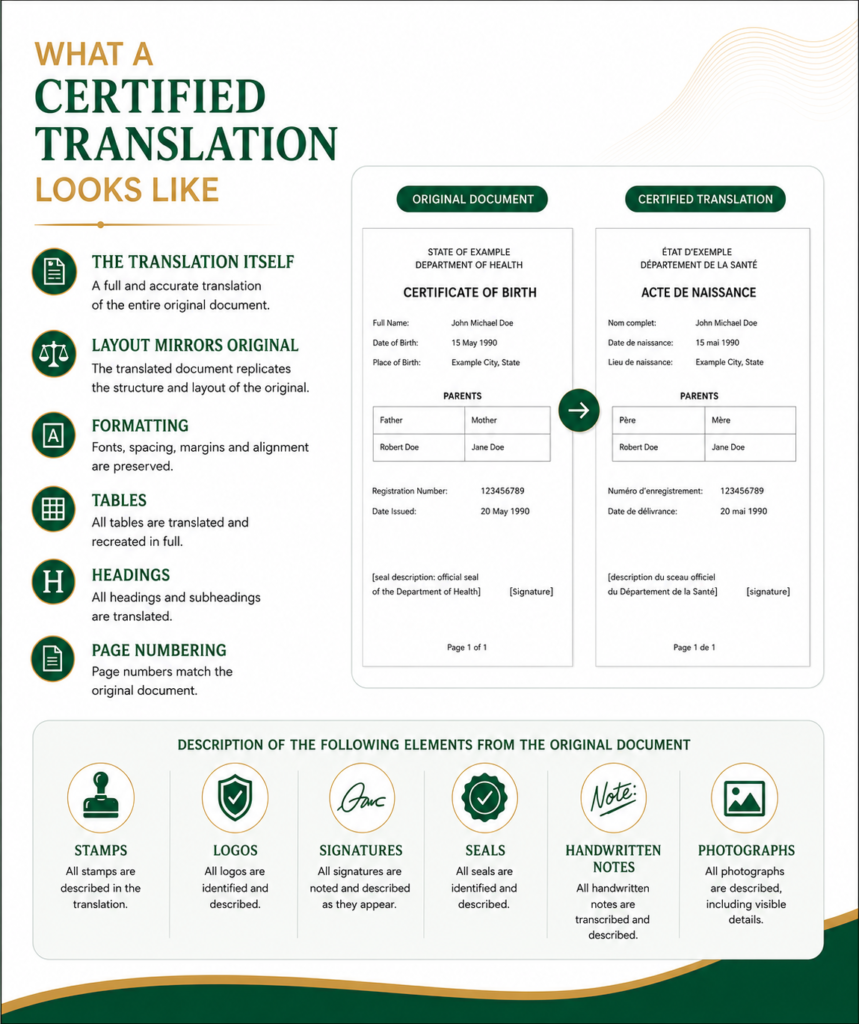
A certified translation should reproduce the layout and structure of the original document as closely as possible. This makes it easier for the receiving authority to compare the translation with the source document and verify that nothing has been omitted or altered.
Where appropriate, the translation should preserve:
- headings and subheadings;
- page numbering;
- headers and footers;
- tables and columns;
- handwritten annotations; and
- any other textual elements appearing in the original.
Non-textual elements such as logos, seals, stamps, signatures, photographs and official emblems should not be copied or reproduced in the translation. Instead, they should be described in square brackets—for example, [Official stamp], [Illegible signature] or [Passport photograph].
There are several reasons for this. Reproducing official stamps, seals or signatures could create confusion as to whether the translated document is an original, raise concerns about authenticity or tampering, and, in some cases, infringe copyright or other intellectual property rights. A certified translation should always remain clearly identifiable as a translation of the original document, never as a substitute for it.
Similarly, any text that is illegible, obscured or missing from the original should be indicated transparently, for example [Illegible] or [Text obscured], rather than guessed or omitted.
Below is a simple example illustrating how these conventions are applied.
The Certification
The translation should be accompanied by a certificate of accuracy, normally prepared on the translator’s or translation company’s letterhead.
Although the precise wording and format varies, a professionally prepared certificate will usually contain:
- a heading identifying the document(s) translated;
- a statement confirming that the translation is a true and accurate translation of the original document;
- the date of certification;
- the translator’s name and contact details;
- the translator’s professional qualifications and memberships, where applicable;
- the translator’s signature.
Many certificates use wording such as “I certify that this is a true and accurate translation of the original document.” Others add the qualification “to the best of my knowledge and belief.” In many respects, this latter formulation is preferable, as it recognises an important reality of translation: while every effort is made to produce a faithful and accurate translation, translation inevitably involves professional judgement and interpretation.
Translators who have successfully met the accreditation requirements of recognised professional bodies may also use certification stamps issued by those organisations. For example, a Chartered Linguist or qualified member of the Chartered Institute of Linguists (CIOL) may affix an official CIOL certification stamp to the translation or certificate. While this is not a legal requirement, it provides the receiving authority with additional assurance of the translator’s professional credentials and commitment to recognised standards.
Below is a simple example of a certificate of accuracy. *
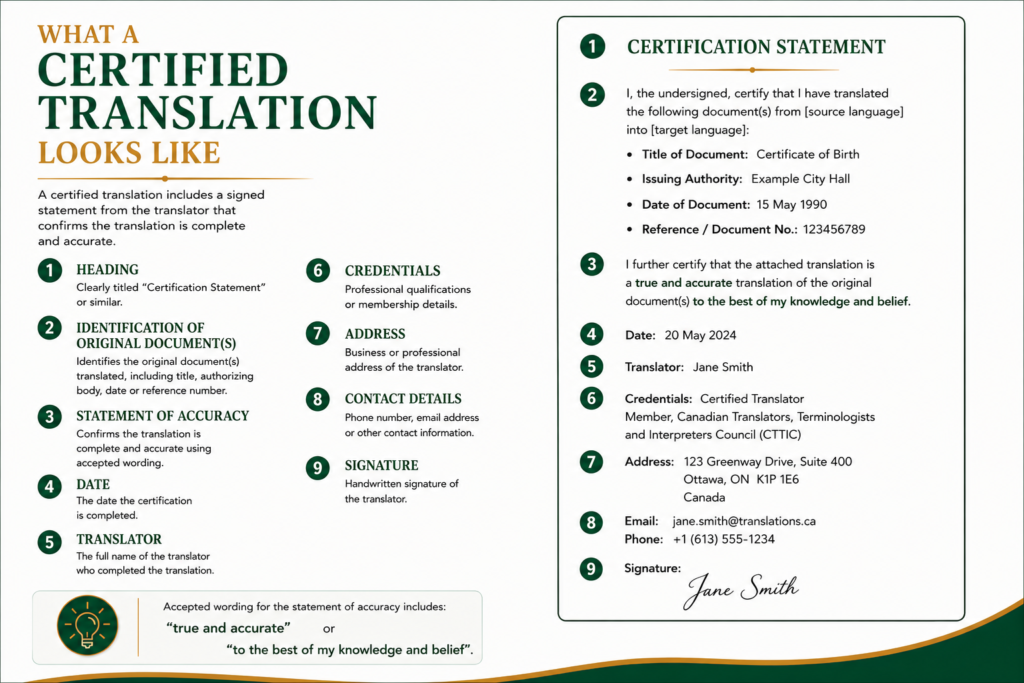
* It must be reiterated that this is merely an example and that different translators may use different wording and layouts.
8. Choosing a Certified Translation Provider
Not all certified translation providers are created equal. While price and turnaround time are undoubtedly important, they should never come at the expense of quality or acceptance by the receiving authority.
Before commissioning a certified translation, make sure your chosen provider satisfies the following essential criteria.
Essential requirements
A competent certified translation provider should:
- be a native speaker of the target language;
- have an excellent command of the source language;
- possess specialist knowledge and experience in the relevant field (for example, legal, academic or financial translation);
- be able to meet the certification requirements of the authority to which the translation will be submitted.
The last point is particularly important. As discussed earlier, different authorities—and indeed different countries—have different requirements regarding certification. A translation that is perfectly acceptable for one authority may not satisfy the requirements of another.
Credentials that inspire confidence
While not always mandatory, professional qualifications and memberships provide valuable reassurance that the translator has been trained, assessed and is committed to recognised professional standards.
Look for credentials such as:
- a degree or postgraduate qualification in translation or a relevant specialist subject;
- membership of recognised professional bodies such as the Chartered Institute of Linguists (CIOL) or the Institute of Translation and Interpreting (ITI);
- extensive experience of translating the type of document you require;
- a willingness to explain the certification process and answer your questions.
Transparency and communication matter
A professional translation service should also be straightforward to deal with. Look for a provider who offers:
- clear and transparent pricing, with no hidden charges;
- a simple quotation and ordering process;
- realistic turnaround times;
- prompt responses to enquiries;
- clear terms and conditions.
Be wary of prices that seem too good to be true. Extremely low prices may indicate that the work is being outsourced to inexperienced or poorly qualified translators, or that additional charges will be added later. When it comes to certified translations, accuracy and acceptance are ultimately far more important than saving a few pounds.
Agency or freelance translator?
Many clients automatically assume that a translation agency is the safest option. In reality, working directly with an experienced freelance translator can offer a number of advantages.
Direct communication with the translator means your questions can be answered quickly and accurately, without messages being filtered through a project manager. You also benefit from knowing exactly who is responsible for your translation and certification.
For straightforward certified translations, a specialist freelance translator can often provide the same—or an even higher—level of service as an agency, while offering greater continuity, more personalised advice and, in many cases, more competitive pricing.
For large multilingual projects or assignments requiring desktop publishing and extensive project management, however, an agency may be the more appropriate choice.
Conclusion
Certified translation is about much more than producing an accurate translation of a document. It is about ensuring that the translation satisfies the legal and procedural requirements of the authority for which it is intended, while remaining a faithful representation of the original.
As we’ve seen, those requirements can vary significantly from one country to another—and even between different organisations within the same country. Understanding the distinction between certified, sworn, notarised and apostilled translations, and choosing a suitably qualified translator, can save considerable time, expense and frustration.
Whether you are applying for a visa, registering a marriage abroad, submitting documents to a university or dealing with cross-border legal matters, investing in a professionally prepared certified translation gives you the best chance of your documents being accepted the first time.
Need a Certified Translation?
If you’re unsure what type of translation you need, I’d be happy to help.
Simply send me a scan of your document (or documents) together with details of the authority to which they will be submitted. I’ll advise you on:
- whether you need a certified, sworn, notarised or apostilled translation;
- any specific requirements of the receiving authority;
- the likely turnaround time;
- the cost before you commit to anything.
As a qualified legal translator with more than 20 years’ experience, I provide certified translations into English for clients around the world. Where a sworn translation into Spanish or Italian is required, I can also arrange this through trusted professional colleagues accredited in their respective jurisdictions.
If you’d like to discuss your requirements or request a no-obligation quotation, please get in touch. I’ll be happy to guide you through the process and help ensure your documents meet the necessary requirements from the outset.
Need a Certified Translation?
Whether your documents are for a visa application, university, court, registry office or another official authority, I’ll help you ensure they meet the correct certification requirements.
Simply send me a copy of your document together with details of where it will be submitted. I’ll advise you whether you need a certified, sworn, notarised or apostilled translation and provide a no-obligation quotation.
