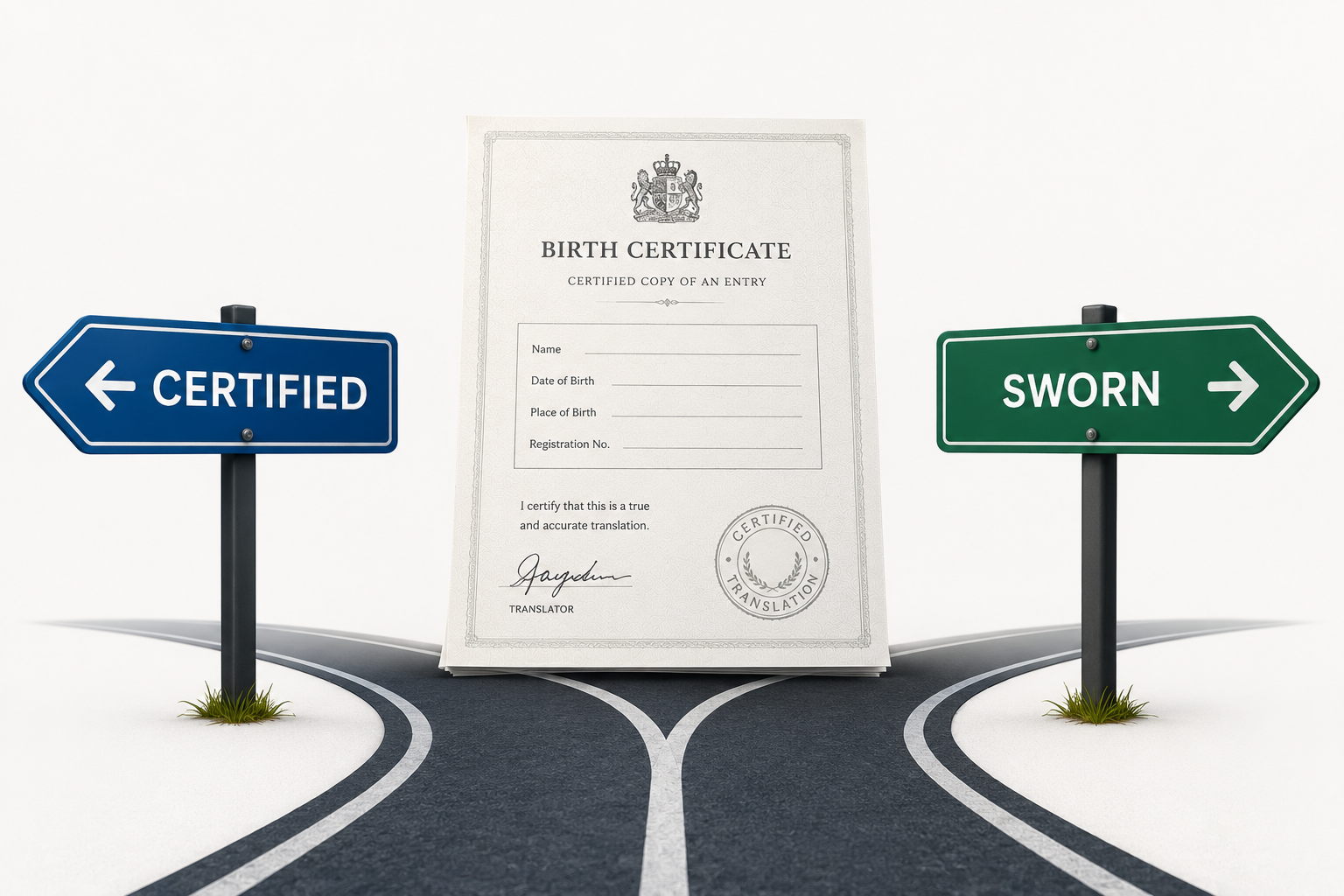
If you’ve been told that you need a certified or sworn translation, you’re not alone in feeling confused. The terminology is far from straightforward. A translation that is perfectly acceptable in one country may be rejected in another simply because the receiving authority follows a different certification system.
The important point is this: what matters is not what the translation is called, but whether it satisfies the requirements of the authority requesting it.
If you’re looking for a comprehensive explanation of certified translations—including who can certify them, what a certificate of accuracy should contain, and how certified, notarised and apostilled translations differ—you may wish to read my Complete Guide to Certified Translation. In this article, we’ll focus on one specific question: what is the difference between a certified and a sworn translation, and how do you know which one you need?
Certified or sworn? What’s the difference?
In simple terms, a certified translation is accompanied by a certificate in which the translator (or, in some countries, a translation company) confirms that the translation is a true and accurate representation of the original document.
A sworn translation, by contrast, is one that carries official legal status because it has been produced, or formally certified, by a translator authorised by the competent authority in that jurisdiction. In Spain, for example, a sworn translation must be performed by a translator accredited by the Ministry of Foreign Affairs, European Union and Cooperation in order to have legal authority.
The distinction largely reflects two different legal traditions. Common law countries, such as the United Kingdom, generally rely on the professional responsibility of the translator and therefore use certified translations. Many civil law countries, including Spain, have a system of officially appointed or accredited sworn translators whose translations are recognised directly by public authorities.
The table below summarises the main differences between the two concepts.
| Certified translation | Sworn translation |
| Certified by the translator (or, in some countries, a translation company) | Produced or certified by a translator authorised by a public authority |
| Common in common law countries such as the UK, Ireland, the USA and Australia | Common in civil law countries such as Spain and France |
| Accompanied by a certificate of accuracy | Bears the official stamp and signature of the sworn translator |
| Acceptance depends on the receiving authority | Has legal status under the law of the country concerned |
The type of translation needed therefore usually depends on where you are. However, even within different countries, the distinction is not always clear.
Common Exceptions and Sources of Confusion
“Sworn translation” in the United Kingdom
Although the United Kingdom has no system of officially appointed sworn translators, the expression sworn translation is sometimes used, particularly by overseas authorities or clients unfamiliar with the UK system.
In practice, what is usually meant is a notarised translation. In these cases, the translator signs the certificate of accuracy before a notary public (or, less commonly, a solicitor), who verifies the translator’s identity and witnesses the signature. The notary does not certify the translation itself; they certify the authenticity of the translator’s signature.
Italy’s Assseveration Procedure
Italy follows a different approach again. Rather than maintaining an official register of sworn translators like Spain, translations required for official purposes are often asseverated (traduzione asseverata or traduzione giurata).
During the asseveration procedure, the translator swears before the competent court or other authorised official that the translation faithfully reflects the original document. Once the oath has been administered, the translation acquires official status for the purposes for which it was requested.
Because procedures vary between courts and according to the receiving authority, it is always advisable to check the applicable requirements before commissioning a translation.
What happens if you choose the wrong type?
Choosing the wrong type of translation can have significant consequences. Your documents may be rejected outright, you may be asked to obtain a fresh translation, or your application could be delayed while you meet the correct requirements. In some cases—particularly where visas, court proceedings or property transactions are involved—these delays can have serious financial or legal consequences.
For this reason, it is always worth confirming the exact requirements with the receiving authority before commissioning a translation.
Can a certified translation be turned into a sworn translation?
A sworn translator is professionally responsible for the translation they certify. They cannot simply place their stamp or signature on another translator’s work. In almost all cases, they will need to translate the original document themselves before certifying or swearing the translation in accordance with the applicable rules.
Still not sure which type of translation you need?
If there is one thing to take away from this article, it is that there is no universal answer. Whether you need a certified, sworn, notarised or asseverated translation depends entirely on the requirements of the authority receiving your documents.
If you’re unsure, don’t guess.
Simply send me a copy of your document together with details of where it will be submitted, and I’ll advise you on the type of translation required before you incur any unnecessary expense.
As a specialist legal translator, I provide certified translations into English and work with a trusted network of sworn translators in Spain and Italy, enabling me to assist with official translations across all three jurisdictions.
Don’t leave it to chance
Every authority has different requirements, and using the wrong type of translation can be costly. Send me a scan of your document and let me know where it will be used. I’ll explain exactly what’s required and provide a no-obligation quotation.
